
Leadership: Body of Christ as Ministry Team
The Church is like a harp, composed of different strings, each giving forth its own tone. It is only in concert that the melody is made perfect. Hippolytus of Rome
Gregg’s Reflection
For some time, I have been thinking and talking about Ministry Teams as a current day manifestation of the Body of Christ. If we explore this analogy, let’s see where it takes us. To remember their last strong team experience, many have to reach far back in the past to a sports team from their youth. It seems rare that people have experienced true collaboration in a work group setting.
Team is one of the most misused terms in the lexicon today. How many times have we seen church committees renamed teams, and nothing else changed? I have worked in groups, both at work and church, my whole adult life. The typical group output was a total not equal to the sum of the parts. Most groups operated somewhere between 40-90% of the potential of the individuals. Hence, the expression, “A camel is a horse designed by a committee.”
Teams, on the other hand, are about synergy. Look at the great sports teams. Everyone contributes out of their strengths, or they are not on the team. Everyone is clear about their role. They pursue team goals before their own agenda. Expectations are clear. Norms of behavior are important. It is a rare church committee that exhibits these traits.
I never experienced an effective team until my EMBA at Georgia State University. Our cohort of 50 had to self-organize into work teams that would stay together for the entire two years of the program. Team projects often made up the majority of the class grade. Through a very intentional process of developing a covenant, clear roles, expectations, consequences and norms, five of us bonded into a wonderful team.
Dialog vs. Discussion
Our work projects emerged from dialog among very diverse people on the team. Dialog is equal parts inquiry and advocacy. More often in groups we use discussion, which comes from the same root as percussion. I beat you over the head with my ideas. While I’m talking, you’re not listening to me, but instead thinking about your rebuttal. As soon as I take a breath, you jump in and beat me over the head with your ideas. Rarely do we change each other’s minds. One of the great interventions when this is happening is to set a norm that you must first restate the other person's points before making your own.
Whole > Sum of the Parts
Inevitably, the product of our EMBA work team exceeded the sum of the parts. We created true synergy where we compensated for each other’s blind side, and contributed to great work together. We came from opposite ends of the personality and conflict resolution spectrums, had to reconcile gender and cultural differences. What made it all possible was the development of trust and respect that allowed us to hear very different opinions and learn from each other. Relationship was a critical factor.
Focus on Task and Relationship
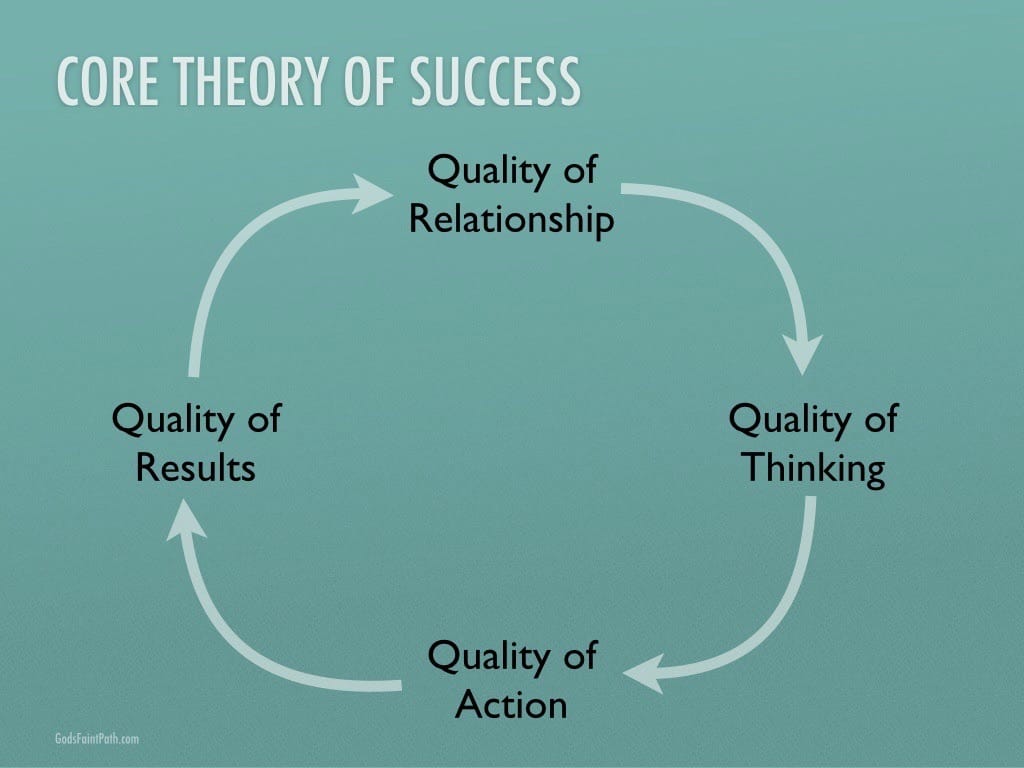
Most groups are focused on the tasks to be done. Managing relationships is secondary at best. In teams, you do the work, and then you examine how you are working together. If a lumberjack spends all the time sawing wood, and never stops to sharpen the saw, his productivity slows and slows. Caring for each other, and developing trusting relationships is how we sharpen the saw in teams. Relationship creates the environment where synergy can develop. In Ministry Teams, we add prayer and study time to the mix, and we create the opportunity for the Body of Christ to emerge. For more on this, see the Core Theory of Success.
The natural tendency is to let differences among us divide us. Learning to value differences and bridge them is core work of team. Scripture shows us that we are to find unity in diversity, to each find our gifts and our place in the Body of Christ. We see that these gifts are to work together in concert so the Body of Christ can be built up. It’s as if God has composed a symphony, and we each have our own part. The symphony can only be realized when we can blend ourselves together under the Spirit's leadership.
Team building methodology is all about blending diversity into a strong team where weaknesses become irrelevant because others on the team have strengths where we are weak. We overcome our differences and learn to trust those who can help us see our blind side. Building strong relationships helps us overcome defensiveness.
When I join a meeting and find people with very different culture and style preferences around the table, it mostly just aggravates me. Only with the very intentional work of covenanting to become a team can we truly begin to appreciate the diversity of the team. As we begin to trust and appreciate a diverse team, dialog can emerge. Out of true dialog, synergy can flow.
In group work with my company, I rarely found that meetings resulted in better ideas than I brought into the room. When I've worked with a strong team, the end product is inevitably better than the idea I brought to the team. When that team is intentionally making room for listening and discerning where the Spirit is leading, true Kingdom synergy can emerge. And, the culture that is created can draw our individual sparks together to make a strong flame, one that is contagious, and draws others towards Christ. To find your place in the Body of Christ, see my post on Discover your Design.
Wade in to seeing the Body of Christ as Team. Blessings.
Journaling Prompts
When have I been part of a true team that brought out the best in everyone? What behaviors or habits in group settings prevent synergy and trust? How do I respond to people with different styles, temperaments, or cultural expressions? In what ways can I help my ministry team grow in trust, prayer, and shared discernment?What would it look like for our team to truly listen for the leading of the Spirit?
Scripture
How good and pleasant it is when God’s people live together in unity!
Psalm 133:1
Jesus Prays for All Believers that all of them may be one, Father, just as you are in me and I am in you. I in them and you in me. May they be brought to complete unity to let the world know that you sent me and have loved them even as you have loved me.
John 17:21,23
Just as each of us has one body with many members, and these members do not all have the same function, so in Christ we who are many form one body, and each member belongs to all the others. We have different gifts, according to the grace given us.
Romans 12:4-7
For just as the body is one and has many members, and all the members of the body, though many, are one body, so it is with Christ…For the body does not consist of one member but of many.... But God has so composed the body ... that there may be no discord in the body, but that the members may have the same care for one another. If one member suffers, all suffer together; if one member is honored, all rejoice together. Now you are the body of Christ and individually members of it.
1 Corinthians 12:12-14, 24-27
But to each one of us grace has been given as Christ apportioned it. It was he who gave some to be apostles, some to be prophets, some to be evangelists, and some to be pastors and teachers, to equip God's people for works of service, so that the body of Christ may be built up.
Ephesians 4:7, 11-12
From him the whole body, joined and held together by every supporting ligament, grows and builds itself up in love, as each part does its work.
Ephesians 4:16
Each of you should use whatever gift you have received to serve others, as faithful stewards of God’s grace in its various forms. If anyone speaks, they should do so as one who speaks the very words of God. If anyone serves, they should do so with the strength God provides, so that in all things God may be praised through Jesus Christ.
1 Peter 4:10–11
Ancient Writing
In the orchestra of the Lord, every instrument must be tuned to love. Only then can the music of the Gospel be heard clearly.
Origen of Alexandria, Homilies on Luke
The Church is like a harp, composed of different strings, each giving forth its own tone. It is only in concert that the melody is made perfect.
Hippolytus of Rome, Commentary on Daniel
Truth is born in the process of communal searching, not in private assertion.
Benedict of Nursia, Rule of St. Benedict, Prologue & ch. 3
When each one does his own work, the whole body is healthy. But if one part fails, the whole suffers. In the Church, as in the body, each one must take care of the others.
John Chrysostom, Homily on 1 Corinthians 12
The eye cannot say to the hand, I have no need of you. Neither can the head say to the feet, You are not part of us. For all are members, all are necessary.
St. Augustine, Sermon 267, on the unity of the Church
Harmony exists when the stronger uphold the weaker, and the weaker do not envy the stronger. Unity is not uniformity but concord in diversity.
Gregory the Great, Pastoral Rule
Modern Writing
We call it a gift and we call ourselves gifted, but gifts are never really earned, are they? Only given. Talent is grace made visible.
Stephen King, You Like It Darker: Stories, p. 53
People support what they help to create.
Marvin Weisbord, Productive Workplaces, p. 251
A team is not a group of people who work together. A team is a group of people who trust each other.
Simon Sinek, Leaders Eat Last, p. 25
True dialogue is not just talking together. It is thinking together — creating the possibility of new insights that none of us could achieve individually.
Peter Senge, The Fifth Discipline, p. 241
The strength of the team is each individual member. The strength of each member is the team.
Phil Jackson, Sacred Hoops: Spiritual Lessons of a Hardwood Warrior, p. 145
In community, we learn to hold our differences not in judgment, but in a field of grace.
Parker J. Palmer, A Hidden Wholeness, p. 116
The body of Christ is not just a metaphor. It is a mystical reality of shared life, where each contributes a thread to the tapestry of God’s work.
Richard Rohr, The Naked Now, p. 119
The whole is greater than the sum of its parts — not just in theory, but in practice, when people learn to trust each other.
Margaret J. Wheatley, Leadership and the New Science, p. 40
In the spiritual life, the quality of our presence to one another can be as important as any word we say.
Henri Nouwen, The Living Reminder, p. 51
True community is not the absence of conflict but the presence of a reconciling spirit.
Jean Vanier, Community and Growth, p. 55
Teamwork begins by building trust. And the only way to do that is to overcome our need for invulnerability.
Patrick Lencioni, The Five Dysfunctions of a Team, p. 195
Dialogue is the art of thinking together.
William Isaacs, Dialogue and the Art of Thinking Together, p. 19
If the church is to be the Body of Christ, then every part must be both honored and engaged. Anything less distorts the image of Christ in the world.
Howard Thurman, The Search for Common Ground, p. 104