
Leadership: Embracing the Future, not the Past
We do not think ourselves into a new way of living; we live ourselves into a new way of thinking. Richard Rohr

Gregg’s Reflection
I have found that letting go is the primary gesture of the spiritual journey. I wrote about it in this post: Letting Go, Surrender, Kenosis. As I have moved into the deeper second half journey, I have encountered several seasons of pruning and letting go. In 1999, I let go of our business in order to pursue a calling. In 2009, I suffered the biggest failure as I let go of a project to equip pastors as disciple-making leaders in the Lutheran tribe. In 2019, we let go of our home in Atlanta to move to Colorado full time. And, this year, we are letting go of the off grid log cabin we built as our ‘forever’ home.

Pruning is painful but necessary to usher in a new season of fruitfulness. Yet, in my work with churches, I find the biggest obstacle to finding new life is clinging to the old. I was at a retreat years ago with Don Saliers, who taught liturgy at the Candler School of Theology. He said, “I wish that all those people who long for tradition would look farther than 50 years into the past. I wish they would honor the traditions of the first century, of the early Christians, of the Reformation. I think they are not honoring tradition, but traditionalism.”
When I was on staff at the ELCA Southeastern Synod, we did an annual leadership retreat called Catch the Spirit. One year, we invited Leonard Sweet as our speaker.

In our conference, Sweet told us he is a futurist and an historian. He spoke of the need for a new Reformation in the church. This image from my post on the Life Stages of Organizations shows why this is true.
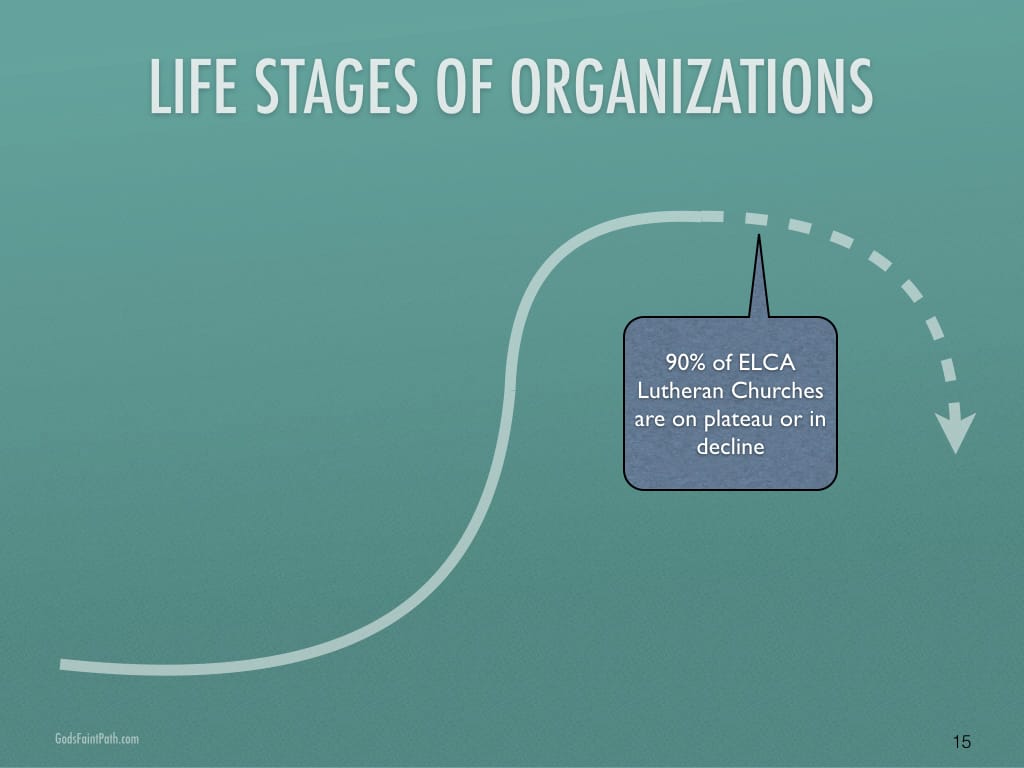
We have moved into a new century, from the modern to the postmodern era. Churches that survive and thrive in the post-modern era are doing so with an ancient/modern operating system. My friend Harvey Cheatham made this observation, “I think the old forms of the church are breaking apart, releasing Spirit to create a new church for a new era.
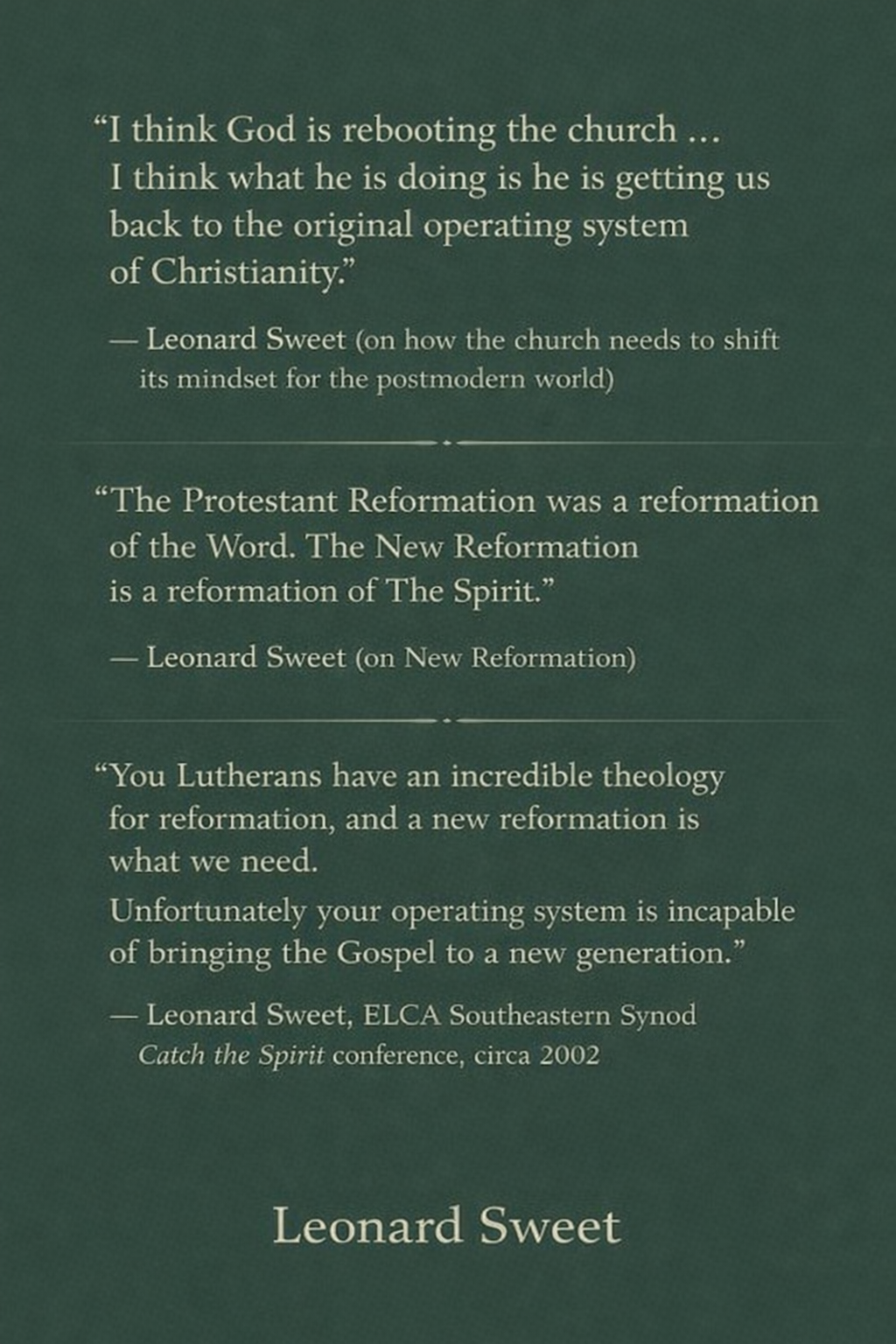
In his keynote address to Catch the Spirit, Sweet made this profound point:
Mike Breen of the 3DM Movement said it this way:
I was trained for Temple duty. Most pastors have been trained by Seminary so that their operating system is the church. Unfortunately, that is not the operating system of Jesus. His operating system was discipleship. We start churches and hope discipleship happens, and it rarely does. When we start with discipleship, God will build the church.
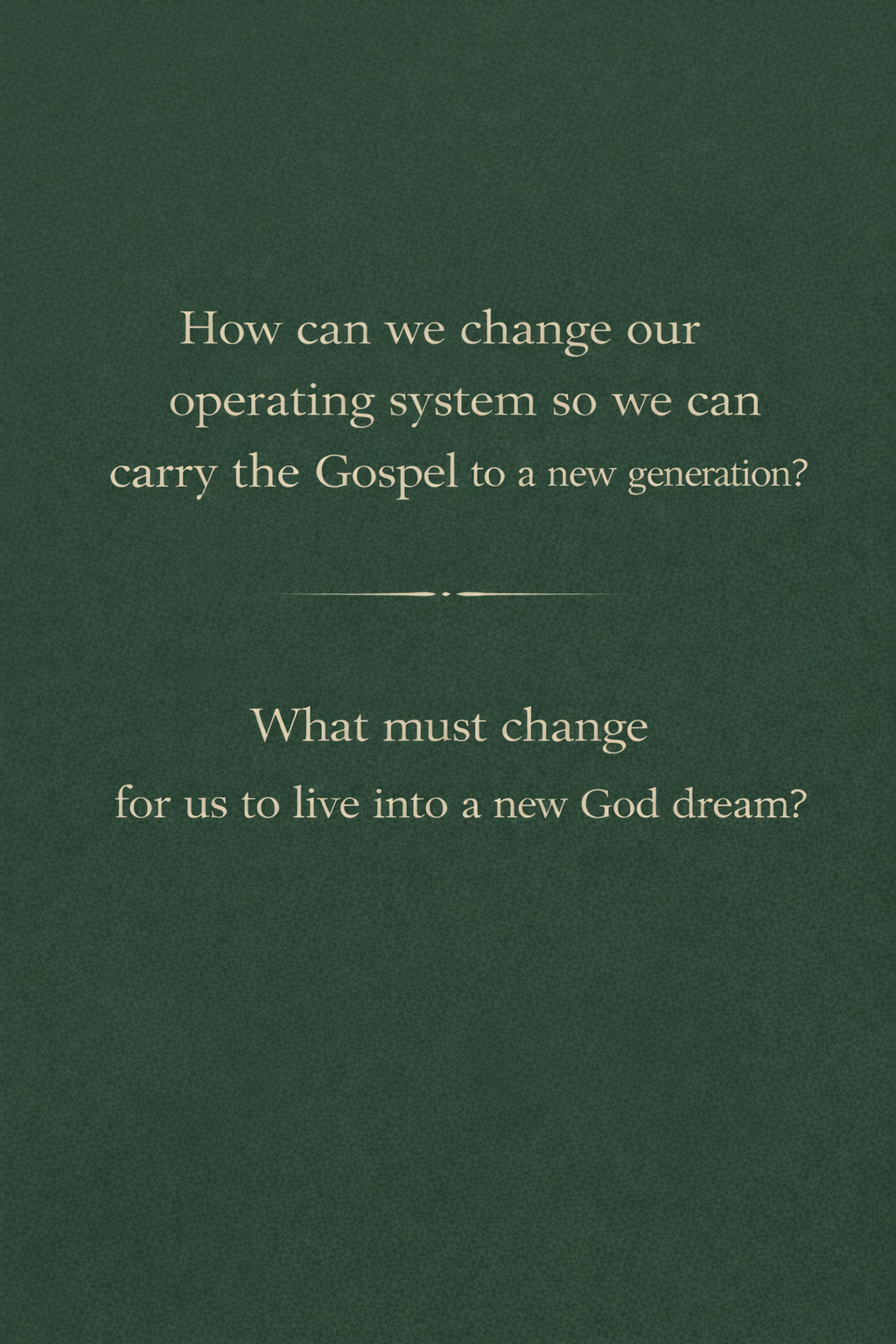
I am working with our pastor and a Vision team at our church, and we are trying to answer this question:
After leaving my Lutheran project, I joined the staff of a Presbyterian (PCA) church plant. I spent ten years living in a church centered on discipleship and serving our local parish through missional communities. It was profound to see what is working. CityChurch Eastside has about 250-300 coming to worship on a Sunday with 75 kids. I created a workshop called Discover your Design to help people connect with their spiritual gifts, values and passions so they might begin to discern their calling.
So, how do we return to an operating system of discipleship? Jesus modeled a pattern of Invitation and Challenge. Everyone Jesus encountered, he first loved them, then he challenged them to grow up. Most Lutheran churches are good at invitation, but totally neglect challenging people to grow.
For discipleship to take hold, it begins with the pastor and the leaders of the church. If they don’t embrace discipleship, the people never will. As Richard Rohr says,
We could not see what we had not been told to see or what our teachers themselves had never experienced.
And, the reality is that many if not most Lutherans have never seen a church centered on Discipleship. The transformation required to make a shift to discipleship is a hard road. It looks like this:

The arrow shows that the journey from being a High Invitation/Low Challenge church to a Discipling culture will take you through the bottom right quadrant before you get to the upper right. That illustrates the pain of letting go and letting things die so new fruit can grow.
This will only emerge if people are free to say ‘no’. Churches are free to continue on the path they have been on, but it has consequences. Churches can hold our hands as we age and die, but the church itself will end up in hospice when there are too few people and financial resources to keep it going.
If you are willing to take a step forward, let’s see what the journey looks like. When I research what this new operating system looks like, here is what I find:
1. From Institutional Preservation → Missional Participation
What must change: We stop asking “How do we keep the church going?” and begin asking “Where is God already at work, and how do we join?”
A new operating system assumes:
- God is not confined to our buildings or structures
- The Spirit moves ahead of us into culture, pain, and longing
- The church is not the destination, but the vehicle
2. From Information Transfer → Transformational Encounter
What must change: We move from explaining the Gospel to embodying it.
For generations, the church assumed that if people:
- Heard the right doctrine
- Understood the correct beliefs
- Agreed with the truth claims
…faith would naturally follow.
But a new generation is not primarily asking:
- “Is this true?”
They are asking: - “Is this real?”
- “Does this heal?”
- “Does this make anyone more loving, more whole, more free?”
A new operating system understands that: - Information alone does not transform
- Belief without practice rarely endures
- Truth must be experienced to be trusted
This does not mean abandoning theology. It means recovering its purpose. The Gospel is not first an idea to be defended, but a life to be entered. Jesus did not hand out syllabi. He invited people to:
“Come and see.”
Transformational encounter happens when communities become places where people can:
- Taste grace before they can name it
- Belong before they believe
- Practice love before they can articulate faith
In such communities:
- Prayer is experienced, not merely taught
- Forgiveness is practiced, not just proclaimed
- The presence of God is discerned, not assumed
This is how faith takes root in a skeptical age — not through argument, but through encounter.
3. From Control and Certainty → Trust and Discernment
What must change: We loosen our grip on control and relearn how to listen.
Many church systems are built on:
- Predictability
- Risk management
- Clear answers before faithful action
But the Gospel emerged from:
- Wilderness
- Questions
- Trusting the Spirit day by day
A new operating system assumes:
- God is still speaking
- Discernment matters more than decisions
- Faithfulness often precedes clarity
This requires slowing down, practicing silence, and recovering communal listening—something your Lutheran theology actually knows deeply, even if it has forgotten how to practice it.
4. From Clergy-Centered → Whole-Body Participation
What must change: We stop treating ministry as the job of professionals and rediscover the Body of Christ.
The next generation is suspicious of:
- Religious performance
- Platform-driven leadership
- Spiritual hierarchies
But they are drawn to:
- Authenticity
- Shared leadership
- Lives that align with words
A new operating system releases:
- Every baptized person as a minister
- Gifts over titles
- Community over celebrity
This is not abandoning order—it is recovering vocation.
5. From Fear of Loss → Hopeful Letting Go
What must change: We accept that some things must die so that something truer can live. Jesus is clear: “Unless a grain of wheat falls into the earth and dies…”
Many churches are grieving:
- Shrinking numbers
- Lost influence
- Cultural marginalization
But the Spirit is not asking us to rebuild the past. The Spirit is inviting us to participate in resurrection. A new God dream always looks like loss before it looks like life.
6. From Attractional Models → Incarnational Presence
What must change: We stop asking people to come to us and begin going where life already hurts.
The Gospel spread not through:
- Programs
- Marketing
- Institutional strength
But through:
- Table fellowship
- Shared suffering
- Presence in ordinary life
A new operating system moves: - From “come and see” to “go and dwell”
- From events to relationships
- From relevance to faithful presence
The Deep Shift (the heart of it)
What must change most is who we think God is.
If God is:
- Primarily disappointed → we manage appearances
- Primarily distant → we rely on systems
- Primarily angry → we defend boundaries
But if God is:
- Already present
- Deeply compassionate
- Actively at work in the world
Then our task is not to fix the church, but to join God’s dream already unfolding.
The Question Beneath the Question
The real operating system change is not institutional.
It is personal.
- What must I let go of?
- Where is my fear blocking trust?
- How is God inviting me to live differently now?
Every reformation begins there. And perhaps that is the most Lutheran insight of all: We are justified not by our systems, but by grace.
Journaling Prompts
- What am I currently holding onto that once gave life, but may now be limiting growth?
- Where have I experienced pruning or loss that later opened the door to deeper fruitfulness?
- How have I seen God at work outside the walls of the church, and how might I join that work more intentionally?
- What would it look like for discipleship—not comfort or preservation—to become the operating system of my faith?
- What needs to die in my life or community so that something truer and more alive can be born?
- Where do I sense God inviting me to take a step forward, even without clarity about the outcome?
Scripture
Very truly, I tell you, unless a grain of wheat falls into the earth and dies, it remains just a single grain; but if it dies, it bears much fruit.
John 12:24
Do not remember the former things, or consider the things of old. I am about to do a new thing; now it springs forth, do you not perceive it?
Isaiah 43:18–19
No one puts new wine into old wineskins; otherwise, the new wine will burst the skins… new wine must be put into fresh wineskins.
Luke 5:37–38
Go therefore and make disciples of all nations… teaching them to obey everything that I have commanded you.
Matthew 28:19–20
Ancient Quotes
We must not cling to the letter when the Spirit is calling us forward.
Origen, On First Principles, IV.2
Hope has two beautiful daughters: anger and courage. Anger at the way things are, and courage to see that they do not remain as they are.
Augustine of Hippo, Commentary on the Psalms
God cannot give us anything or lead us anywhere except by taking us out of what we already know.
Meister Eckhart, Sermons, trans. Bernard McGinn
Modern Quotes
We could not see what we had not been told to see or what our teachers themselves had never experienced.
Richard Rohr, Naked Now P. 113
We do not think ourselves into a new way of living; we live ourselves into a new way of thinking.
Richard Rohr, Everything Belongs
Christianity without discipleship is always Christianity without Christ.
Dietrich Bonhoeffer, The Cost of Discipleship
The church does not have a mission. God’s mission has a church.
Lesslie Newbigin, The Gospel in a Pluralist Society
The path does not unfold by being explained to us, but by being walked.
James Finley, The Contemplative Heart
The future of the church will not be found in new techniques but in a new imagination rooted in God’s action in the world.
Alan Roxburgh, Missional: Joining God in the Neighborhood