
Leadership: Johari Window
There are things about ourselves that neither we nor others are aware of. As these are discovered and shared, the potential for deeper relationships and personal growth increases. Joseph Luft

Gregg’s Reflection
Around the time I left the business world, I stumbled upon the Johari Window. I found it to be a very useful tool of self-discovery. I had learned the value of feedback as we undertook 360 reviews in the last five years of my business career. Those surveys revealed things that others saw in me that I did not see in myself.
Years earlier, at the Christian Businessmen’s Retreat when I was in my 20’s, my friend Richard Kessler saw potential in me that I did not recognize myself. He gave me a tremendous gift that motivated me to raise my sights and live into the potential he saw. In my spiritual journey, God revealed things about me that were hidden to me and to others. These things, often discerned in darkness during meditation, were the key to spiritual growth in my journey.
When I discovered the Johari Window, it depicted four quadrants: Open, Blind, Hidden and Unknown that I had come to understand about myself. When I saw it, I knew it as lived truth. In my structural coaching work, I find structure sessions reveal things in the blind and unknown quadrant. As I help people see gifts they don’t see themselves, they can expand and grow. The idea behind the window is to expand the Open quadrant while shrinking the other three quadrants.
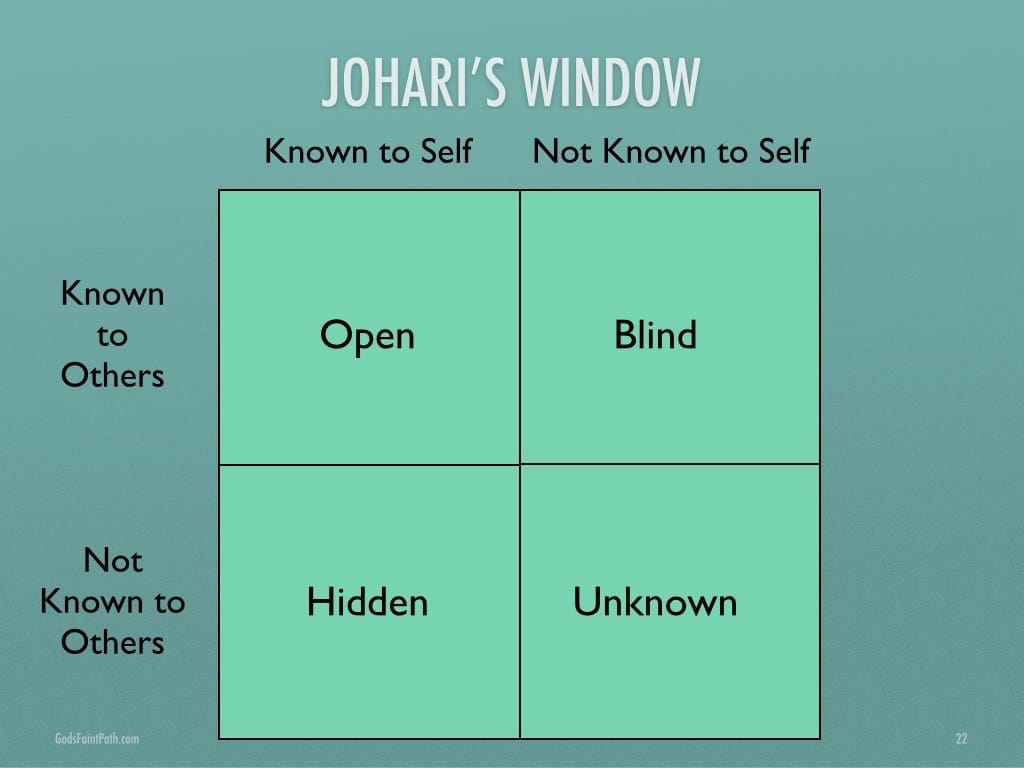
The Johari Window was developed in 1955 by psychologists Joseph Luft and Harrington Ingham as a model for understanding the dynamics of self-awareness, communication, and interpersonal relationships. Named by blending their first names, “Johari” offered a framework to explore what is known and unknown—both to ourselves and to others. Originally used in group development and organizational training, the model gained popularity in psychology and leadership development for its elegant way of illustrating how trust and vulnerability expand our capacity to live and lead authentically.
Though created in a secular context, Johari’s Window mirrors the interior movement of the spiritual life: from hiding to revealing, from blindness to sight, from fear to communion. In the language of formation, it reflects the lifelong process of becoming known—by self, by others, and by God.
The Johari Window is a map of transformation—from unconsciousness to conscious presence, from isolation to relational truth. It helps illustrate the inner journey of formation—and the courageous movement toward integration of what is open, hidden, blind, and mysterious within us. Joseph Lyft explained it this way:
The Johari Window is a simple and useful tool for illustrating and improving self-awareness, and mutual understanding between individuals within a group. A person’s ability to grow depends on being open to feedback from others and also being willing to share aspects of oneself that are not immediately obvious.
In that way, it reflects the Shadow work Carl Jung pioneered and Robert Johnson expanded upon. Jung tells us:
Until you make the unconscious conscious, it will direct your life and you will call it fate.
Robert Johnson tells us:
When you touch your shadow, you tap into a wellspring of energy, creativity, and spirituality that has been repressed.
So, come along and find the pathway to self-discovery and transformation through the Johari Window. Blessings.
Journaling Prompts
What parts of me are I most comfortable sharing with others? Where in my life am I living openly and transparently? How does mutual vulnerability build trust in my relationships? How do I respond to criticism or insight from others? What parts of my story or self am I afraid to share? What would it feel like to bring a hidden truth into the light? Where do I still wear a mask? Where might God be working in me beneath my awareness? What practices help me bring the unconscious into consciousness?
Scripture
Deep calls to deep…
Psalm 42:7
Search me, O God, and know my heart; test me and know my anxious thoughts. See if there is any offensive way in me, and lead me in the way everlasting.
Psalm 139:23–24
The heart is deceitful above all things and beyond cure. Who can understand it? I the Lord search the heart and examine the mind…
Jeremiah 17:9–10
Why do you look at the speck of sawdust in your brother’s eye and pay no attention to the plank in your own eye?
Matthew 7:3
Nothing is hidden that will not be made manifest, nor is anything secret that will not be known and come to light.
Luke 8:17
For now we see only a reflection as in a mirror; then we shall see face to face. Now I know in part; then I shall know fully, even as I am fully known.
1 Corinthians 13:12
Therefore confess your sins to each other and pray for each other so that you may be healed.
James 5:16
But if we walk in the light, as he is in the light, we have fellowship with one another…
1 John 1:7
Ancient Quotes
Know thyself.
Inscription at the Temple of Apollo at Delphi
The unexamined life is not worth living.
Socrates, quoted in Plato’s Apology, 38a
How can you wonder that your travels do you no good, when you carry yourself around with you?
Seneca, Moral Letters to Lucilius, Letter 28
Men are disturbed not by things, but by the view they take of them.
Epictetus, Enchiridion, §5
A man’s errors are his portals of discovery. Let me know myself. Let me know You.
Saint Augustine (adapted), though commonly paraphrased; original spirit in Confessions, Book X
Let each one examine his own thoughts, and so discover what lies hidden within.
Gregory of Nyssa, On the Soul and the Resurrection
To know yourself is the beginning of all wisdom.
Attributed to Aristotle
Modern Quotes
The Johari Window is a simple and useful tool for illustrating and improving self-awareness, and mutual understanding between individuals within a group.
Joseph Luft, Of Human Interaction, p. 3. This quote captures the foundational intent: to increase self-knowledge through relationship.
A person’s ability to grow depends on being open to feedback from others and also being willing to share aspects of oneself that are not immediately obvious.
Paraphrased from Luft and Ingham’s original 1955 training group presentation; summarized in Of Human Interaction, p. 5. Ties directly to the Open quadrant—growth is relational, not solitary.
There are things about ourselves that neither we nor others are aware of. As these are discovered and shared, the potential for deeper relationships and personal growth increases.
Joseph Luft, Of Human Interaction, p. 6. This anticipates the Unknown quadrant—inviting a journey into deeper consciousness.
To the extent that we can be open with ourselves and others, we can develop a greater capacity for understanding, trust, and productive relationships.
Joseph Luft, Of Human Interaction, p. 9. A practical insight into why the Open self matters—for both spiritual and interpersonal flourishing.
What is unknown to self but known to others can be a source of misunderstanding, or a gateway to greater insight, depending on how feedback is given and received.
Summary of Luft and Ingham’s feedback model; see Of Human Interaction, p. 11
Everyone carries a shadow, and the less it is embodied in the individual’s conscious life, the blacker and denser it is.
Carl Jung, Psychology and Religion: West and East, Collected Works Vol. 11, p. 131
No one can become conscious of the shadow without considerable moral effort.
Carl Jung, Aion: Researches into the Phenomenology of the Self, Collected Works Vol. 9ii, p. 14
One does not become enlightened by imagining figures of light, but by making the darkness conscious.
Carl Jung, Alchemical Studies, Collected Works Vol. 13, p. 335
Knowing your own darkness is the best method for dealing with the darknesses of other people.
Carl Jung, often attributed; appears paraphrased in Memories, Dreams, Reflections, ed. Aniela Jaffé, p. 237 (Vintage, 1989)
Projection is one of the commonest psychic phenomena. Everything that is unconscious in ourselves we discover in our neighbor and we treat him accordingly.
Carl Jung, The Philosophical Tree, Collected Works Vol. 13, p. 131. A powerful description of the Blind quadrant—others often bear what we refuse to see in ourselves.
Until you make the unconscious conscious, it will direct your life and you will call it fate.
Carl Jung, The Undiscovered Self
There is in all visible things… a hidden wholeness.
Thomas Merton, Seeds of Contemplation, p. 80
We cultivate love when we allow our most vulnerable and powerful selves to be deeply seen and known.
Brené Brown, The Gifts of Imperfection
The longest journey you will ever take is from your head to your heart.
Attributed to Sioux proverb; echoed in Parker Palmer’s Let Your Life Speak
People can’t see what’s possible in themselves unless someone shows them a mirror.
David Whyte, Consolations: The Solace, Nourishment and Underlying Meaning of Everyday Words, entry: “Hiding”
Faith is taking the first step even when you don’t see the whole staircase.
Attributed to Martin Luther King Jr.; widely quoted, though no exact source confirmed. Closely aligned with themes in Strength to Love
We cultivate love when we allow our most vulnerable and powerful selves to be deeply seen and known…
Brené Brown, The Gifts of Imperfection: Let Go of Who You Think You’re Supposed to Be and Embrace Who You Are, p. 37
The shadow is everything that has been excluded from the ego by negative judgment. It is the ‘not I’—the opposite of how we see ourselves.
Robert A. Johnson, Owning Your Own Shadow, p. 4
People often project their own shadow onto others and then despise them for possessing those qualities.
Robert A. Johnson, Owning Your Own Shadow, p. 7
The shadow is not a problem to be solved; it is a mystery to be faced.
Robert A. Johnson, Owning Your Own Shadow, p. 28. This quote highlight how what we refuse to see in ourselves becomes visible to others—or projected onto them—making this the territory of blindness and relational feedback.
When we hide our shadow, we withhold a tremendous amount of life energy.
Robert A. Johnson, Owning Your Own Shadow, p. 6
We all have a sacred wound. It is the part of our story we most want to hide, and yet it holds the key to our transformation.
Robert A. Johnson, Owning Your Own Shadow, p. 60. Johnson speaks to the cost of withholding parts of ourselves, especially pain or darkness. The “hidden self” becomes a reservoir of power when we risk bringing it into relationship.
The shadow contains not only the darkness, but also the undeveloped potential of the personality.
Robert A. Johnson, Owning Your Own Shadow, p. 8. Johnson calls the gifts we deny having the Golden Shadow. Things you admire in others you might be denying in yourself.
When you touch your shadow, you tap into a wellspring of energy, creativity, and spirituality that has been repressed.
Robert A. Johnson, Owning Your Own Shadow, p. 49. This echoes the mystery of the unknown quadrant—suggesting that our growth lies in bringing the unconscious into consciousness, not through control, but through grace, acceptance, and attention.
To own one’s own shadow is to reach a holy place—an inner center—not attainable in any other way.
Robert A. Johnson, Owning Your Own Shadow, p. 85