
Leadership: Servant Leadership
You become a leader by serving others. You become great by lifting others up. St. Benedict
Gregg’s Reflection
As a student of leadership, I studied many theories of leadership and read many leadership books. Yet, of all the theories I learned, I was most drawn over time to Servant Leadership. It was certainly not the style I learned from my father, and not the one I practiced for the first decade or so of my career. Yet, as I began to read into it, servant leadership was the most aligned with the model of leadership Jesus practiced.
It is a reversal of the pyramid that had the leader on top. In this model, the pyramid is turned upside down, and the leader is serving all. In my own career, I slowly realized it was my job to support the team. I had more resources available to me, and I had to steward those resources so the team could succeed. When they hit a roadblock, it was my job to help them overcome the setback. Here is the model
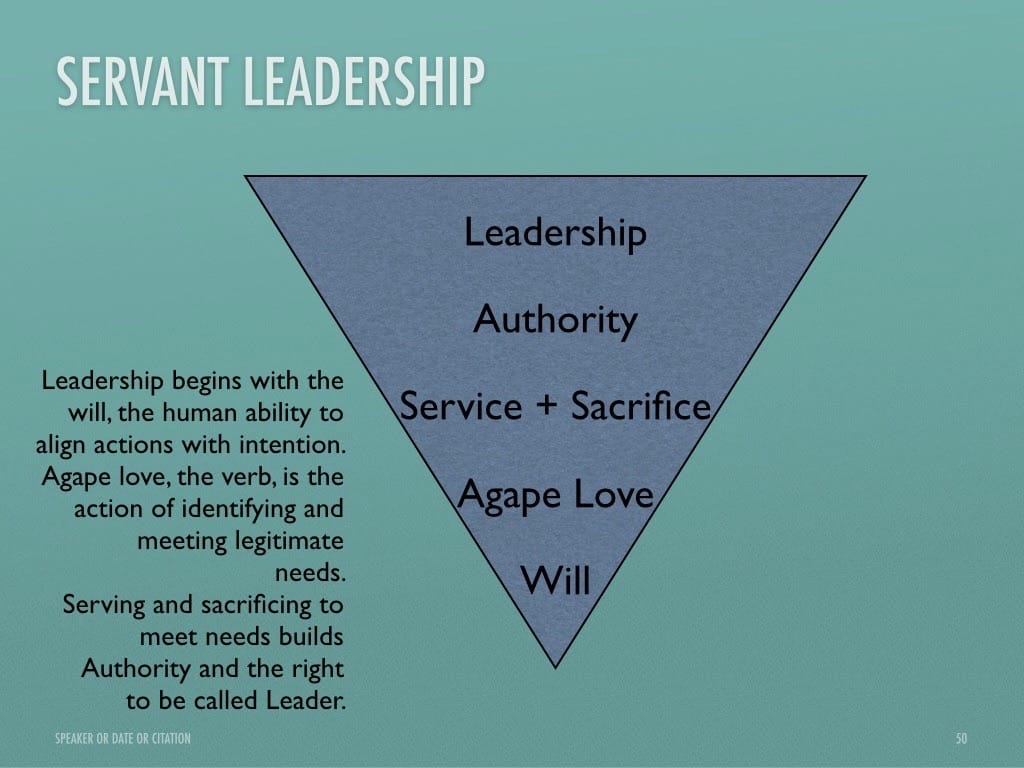
To serve others is an act of will. The next step is to identify and meet legitimate needs. Not wants, mind you, but needs. These are often not the same. The act of sacrificing and serving needs builds authority, and gives us the right to lead.
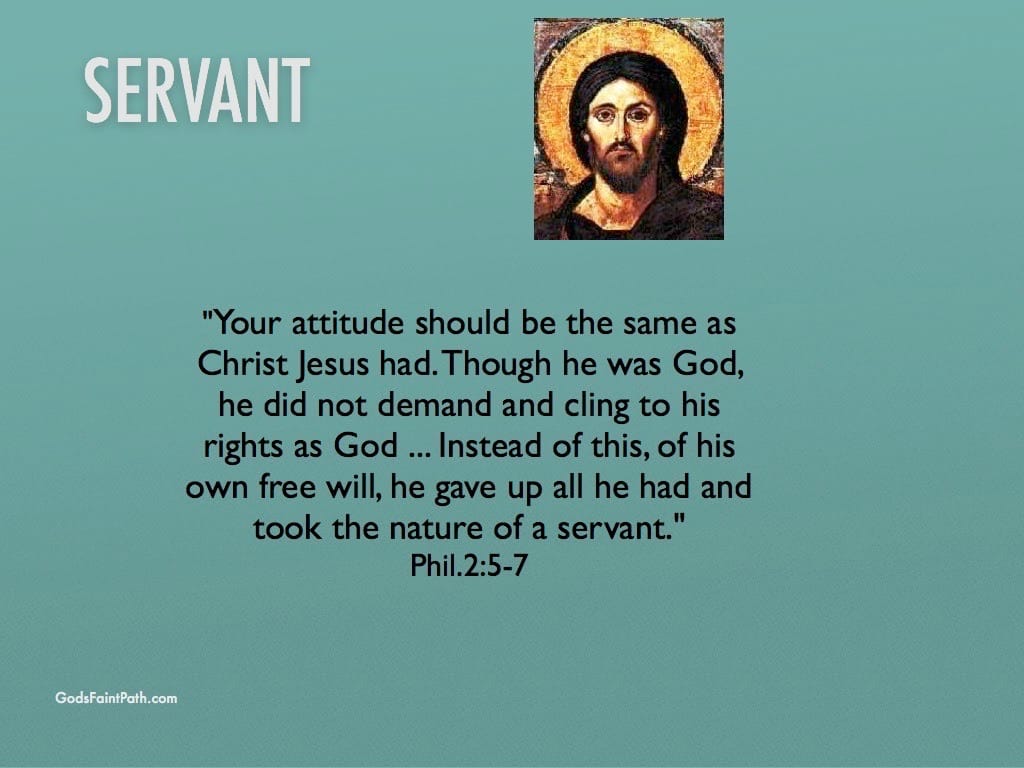
If we follow Jesus’ model, we will take the role of servant. Jesus said it this way:
Whoever wants to become great among you must be your servant, and whoever wants to be first must be your slave—just as the Son of Man did not come to be served, but to serve.
Jesus’ authority came out of his serving people’s needs. How do we get it?
Leaning on power will get you compliance. Leading with authority will get you full commitment.
As we worked to build a learning organization, we needed the full commitment of our people. We understood that they were closest to the customer, and best knew how to improve our processes of serving them. We needed every person to bring their brain to work, and collaborate to create success.
All of these things emerged from leaning into influence and only using power as a last resort. At the end of the day, you need to ask yourself, am I a self-serving or servant leader. If you want to see the best from your people, lean into serving them. Excellence rarely surrounds a self-serving leader.
Since selling the business, I have fully embraced servant leadership. In developing a coaching practice, I focused on uncovering needs and resourcing them. I begin with a structure session, which often reveals motivations emerging from a negative self image. When you are focused on proving yourself worthy, it is hard to focus on serving others. Uncovering that wiring helps people move beyond obligation and live into freedom. So, come along as we explore the leadership Jesus modeled. Learn important lessons about the Credibility of a Leader here. Blessings.
Journaling Prompts
In what ways am I leading from a posture of service rather than control? Who am I called to serve in this season of leadership? How does my leadership reflect the heart of Christ? Am I seeking recognition or quietly empowering others? What would it look like for me to lead from below rather than above?
Scripture
But Moses was a very humble man, more humble than anyone else on the face of the earth.
Numbers 12:3. A powerful example of servant leadership in action.
He has shown you, O mortal, what is good. And what does the Lord require of you? To act justly and to love mercy and to walk humbly with your God.
Micah 6:8
The Spirit of the Sovereign Lord is on me, because the Lord has anointed me to proclaim good news to the poor… to bind up the brokenhearted, to proclaim freedom for the captives…
Isaiah 61:1. Echoes of servant leadership, later applied to Jesus in Luke 4.
”Woe to the shepherds who destroy and scatter the sheep of my pasture!” declares the Lord.
Jeremiah 23:1. A warning against self-serving leadership.
The Lord is my shepherd, I shall not want… He leads me beside still waters. He restores my soul.
Psalm 23:1–3. The Shepherd as the archetype of servant leadership.
You know that the rulers of the Gentiles lord it over them, and their high officials exercise authority over them. Not so with you. Instead, whoever wants to become great among you must be your servant, and whoever wants to be first must be your slave—just as the Son of Man did not come to be served, but to serve, and to give his life as a ransom for many.
Matthew 20:25–28
The greatest among you will be your servant.
Matthew 23:11
The kings of the Gentiles lord it over them… But you are not to be like that. Instead, the greatest among you should be like the youngest, and the one who rules like the one who serves.
Luke 22:25–26
Now that I, your Lord and Teacher, have washed your feet, you also should wash one another’s feet.
John 13:14
Who, being in very nature God, did not consider equality with God something to be used to his own advantage; rather, he made himself nothing by taking the very nature of a servant, being made in human likeness.
Philippians 2:6-7
Be shepherds of God’s flock that is under your care, watching over them… not lording it over those entrusted to you, but being examples to the flock.
1 Peter 5:2–3
Ancient Writings
He who is not a good servant will not be a good master.
Plato, Republic, Book VI
To lead people, walk behind them.
Lao Tzu, Tao Te Ching, Chapter 66
You become a leader by serving others. You become great by lifting others up.
St. Benedict, Rule of St. Benedict, Jesus’ teaching echoed in Matthew 20:26
It is the peculiar quality of a fool to perceive the faults of others and to forget his own.
Cicero, De Oratore, Book III, an early reflection on humility in leadership
Let the brothers who are ministers and servants remember what the Lord says: ‘I have not come to be served but to serve.’
St Francis of Assisi, Rule of 1221, Chapter XVII, in Francis of Assisi: Early Documents, vol. 1, p. 70. Francis directly instructs leaders to see themselves as servants.
Blessed is the servant who does not pride himself on the good that the Lord says or does through him…
St Francis, Admonitions, #17, in Francis and Clare: The Complete Works, p. 45. A call to spiritual humility in leadership roles.
I have done what is mine to do; may Christ teach you what is yours.
St. Francis’ final words to his brothers, as recorded in The Little Flowers of St Francis. This reflects his humility and handing off leadership without clinging to control.
The king is the first servant of the state.
Frederick the Great, 18th-century Prussian king, often cited as the philosophical root of civil servant leadership
Modern Writings
The servant-leader is servant first… It begins with the natural feeling that one wants to serve, to serve first. Then conscious choice brings one to aspire to lead. The difference manifests itself in the care taken by the servant-first to make sure that other people’s highest priority needs are being served. The best test, and difficult to administer, is this: Do those served grow as persons?
Robert Greenleaf, The Servant as Leader, p. 7.
The organization exists for the person as much as the person exists for the organization.
Robert Greenleaf, The Servant as Leader, p. 9. This vision challenged the dominant industrial mindset of his day.
Good leaders must first become good servants.
Robert Greenleaf, The Servant as Leader, p. 12.
The servant-leader always accepts and empathizes, never rejects. He sees what the follower is and what he can become.
Robert Greenleaf, The Servant as Leader, p. 20. I had mentors who could see potential that I could not see myself. What a gift!
Leadership is bestowed by those who are led. It is a status you earn, not a right you claim.
Robert Greenleaf, On Becoming a Servant-Leader, p. 38.
A fresh critical look is being taken at the issues of power and authority, and people are beginning to learn that you don’t have to be in charge to lead.
Robert Greenleaf, Servant Leadership: A Journey into the Nature of Legitimate Power and Greatness, p. 2.
Servant leadership is the only kind of leadership that works in the long run.
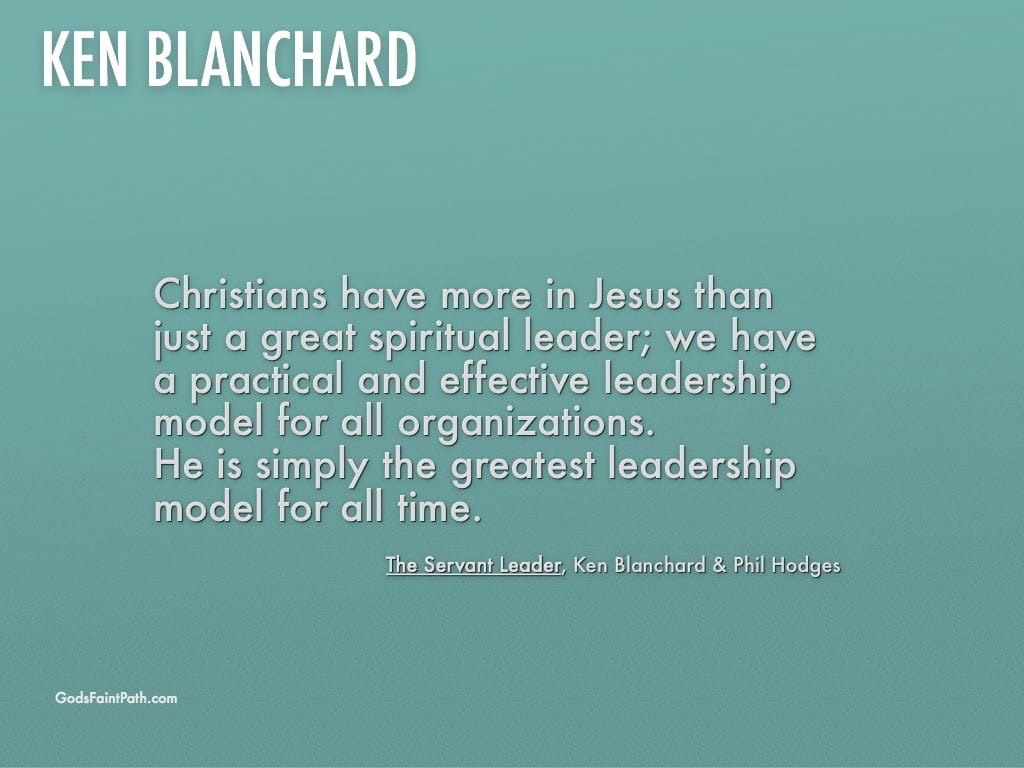
Ken Blanchard, Lead Like Jesus: Lessons from the Greatest Leadership Role Model of All Time
The servant leader is servant first. It begins with the natural feeling that one wants to serve, to serve first. Then conscious choice brings one to aspire to lead.
Ken Blanchard, Servant Leadership in Action: How You Can Achieve Great Relationships and Results
The best leaders realize that their job is to serve, not to be served.
Ken Blanchard, The Servant Leader
People with servant hearts don’t think less of themselves—they just think of themselves less.
Ken Blanchard and Phil Hodges, Lead Like Jesus
Servant leadership is all about making the goals clear and then rolling up your sleeves and doing whatever it takes to help people win.
Ken Blanchard, Servant Leadership in Action, 2018
The measure of a leader is not the number of people who serve him, but the number of people he serves.
John C. Maxwell, The 21 Irrefutable Laws of Leadership, Law #5.
Servant leadership is not about position or power; it is about purpose and people.
Ken Blanchard & Phil Hodges, Lead Like Jesus, p. 19.
Spiritual authority is not given for control, but for service. Not for ego, but for mission.
Henri Nouwen, In the Name of Jesus: Reflections on Christian Leadership, p. 59.
True leaders are distinguished by a deep humility. They don’t claim the spotlight; they shine it on others.
Jim Collins, Good to Great, p. 20.
Level 5 leaders channel their ego needs away from themselves and into the larger goal of building a great company. It’s not that Level 5 leaders have no ego or self-interest. Indeed, they are incredibly ambitious—but their ambition is first and foremost for the institution, not themselves.
Jim Collins, Good to Great, p. 21
Level 5 leaders are a study in duality: modest and willful, humble and fearless. They are incredibly ambitious, but their ambition is for the cause, for the organization and its purpose, not themselves.
Jim Collins, Good to Great, p. 22, 39
I think the term ‘servant leader’ can sometimes be misunderstood as passive or soft. But the great ones, have the humility of a servant and the fierce resolve of a warrior.
Interview with Jim Collins, Leadership Journal, Christianity Today (2005)
Leadership is ultimately about others. It’s about serving.
James C. Hunter, The Servant, p. 16.
Authority is not something you can demand or grab. It is something you earn by serving others.
James C Hunter, The Servant, p. 42.
Leadership is about getting results while building relationships.
James C Hunter, The Servant, p. 65.
True leadership must be for the benefit of the followers, not to enrich the leader.
James C Hunter, The Servant, p. 77.
Love is not how you feel toward others but how you behave toward others.
James C Hunter, The Servant, p. 114. Hunter redefines love in leadership as behavior-based, tying directly to servant values.